
Gershoj Energia Economic Forum
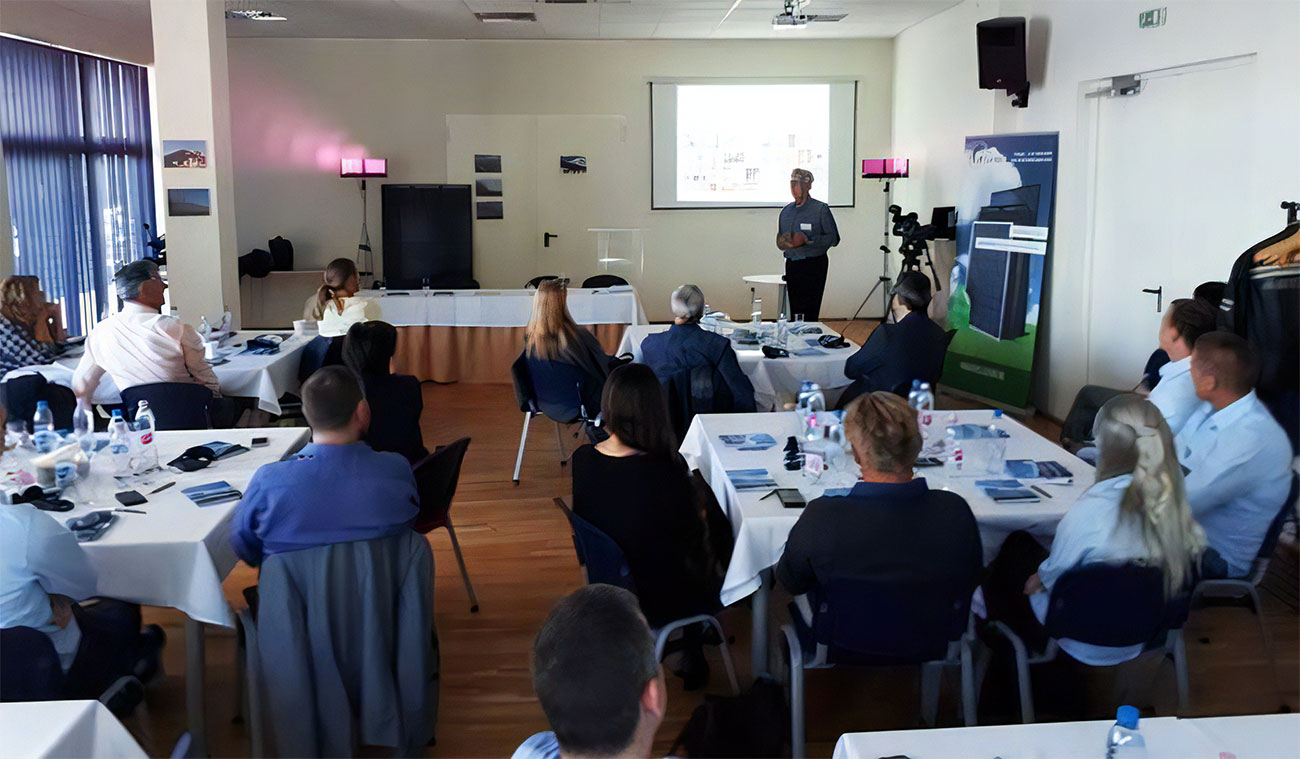
With the launch of the Gershoj Energia Economic Forum, our aim was to create a platform for high‑level dialogue, bringing together perspectives on national and international economic developments, as well as broader business‑critical topics. The forum was designed to help companies strengthen their strategic thinking, understand shifting market conditions, and make better‑informed decisions in an evolving economic environment.
Solar power systems operate reliably for many years, which makes it essential to consider global macroeconomic trends, policy shifts, and long‑term energy market dynamics when planning or investing in new energy solutions. The forum provided a space for exploring these broader forces — helping participants connect local decisions with global realities.
The Gershoj Energia Economic Forum has served as a hub for knowledge exchange, executive networking, and forward‑looking insights. First held in Tata in 2016, it continued annually in subsequent years, offering inspiration and practical value to company leaders.
This private event has been accessible exclusively to our business partners and invited executives. While the forum is currently not active, its legacy remains important to us — and we may resume it in the future should the right opportunity arise.
Speakers of previous conferences:
2019
Dr. Éva Palócz
Kopint-Tárki Economic Analyst Ltd. CEO
Between 1995 and 1998, she worked at the Magyar Nemzeti Bank, gaining deep experience in monetary policy and national financial dynamics. She later became the founder and first director of the Institute of Economic and Business Analysis, established in partnership with the Hungarian Chamber of Commerce and Industry, where she strengthened Hungary’s analytical foundation for business‑focused economic research.
From 2002 to 2007, she served as Deputy Chief Scientific Officer at Kopint‑Datorg Rt., contributing to macroeconomic forecasting, competitiveness analysis, and international economic assessments.
Her presentation focused on the cornerstones of the EU and Hungarian economies, examining structural drivers of growth and competitiveness. She highlighted how, in terms of GDP performance, the newly acceded EU Member States ranked around 7th–8th place in 2018, and demonstrated notable momentum by the first half of 2019, particularly in GDP growth.
The session offered a forward‑looking perspective on macroeconomic trends shaping the region — providing participants with insights essential for strategic business planning.
Gábor Gyimesi and András Kriza
representing Flow Hungary
Gábor Gyimesi is a seasoned expert in process organization and controlling, with more than 20 years of experience building business processes and controlling systems for both SMEs and large corporations. His background spans the design, development, and refinement of operational frameworks that support efficiency, transparency, and sustainable growth.
As an HR Director, András Kriza has worked for major international companies, gaining extensive hands‑on experience in the implementation and operation of HR processes and systems. His expertise covers leadership development, employee experience, organizational culture, and the practical application of HR strategies in complex corporate environments.
Presentation Topic – Achieving and Sustaining “Flow” at Work
Their joint presentation explored the central question of how employers can bring employees into — and maintain them in — a state of “FLOW” at work: a psychological condition defined by deep engagement, intrinsic motivation, joy, and satisfaction derived from meaningful work.
The session highlighted how well‑designed processes, supportive organizational structures, and thoughtful HR systems contribute to creating workplace environments where employees can consistently perform at their best.
(Click on the video to play.)
2018
György Bőgel
professor at CEU Business School
Professor György Bőgel is a highly respected faculty member of CEU Business School, specializing in corporate governance and organizational theory. His work pays particular attention to the IT industry and the ways in which technological advancements reshape corporate structures, management practices, and strategic decision‑making.
He is the author of several books and has published more than one hundred articles in both Hungarian and English, contributing significantly to the region’s understanding of the intersection between technology and governance.
Presentation Topic – Present and Future of Intelligence in the Economy and Society
In his lecture, Professor Bőgel explored the current state and future trajectory of artificial intelligence, highlighting where the world stands today in the rapid development of intelligent systems. He examined the broader consequences of AI for society, including its impact on employment, the shifting distribution of work, and the transformation of traditional economic roles.
The presentation illustrated these trends with a wide range of domestic and international examples drawn from multiple sectors — including industry, agriculture, commerce, and scientific research. Through these cases, he demonstrated how AI is already reshaping competitive landscapes and what this means for organizations preparing for the next wave of technological change.
Tamás Nagy
Head of the MNB's Macroprudential Analysis Department
Tamás Nagy graduated in economics from the Corvinus University of Budapest, specializing in finance. Early in his career, he contributed to domestic macroeconomic and banking‑sector analyses, and later broadened his regional expertise as part of Bank Austria and UniCredit CEE Research, where he examined the operations of major financial institutions across Central and Eastern Europe.
Since 2016, he has served as Head of the Macroprudential Analysis Department at the Magyar Nemzeti Bank (MNB). His department is responsible for several flagship publications, including the Financial Stability Report, the Lending Processes Report, and the Housing Market Report. His work supports systemic risk assessment, prudent policy design, and the long‑term resilience of the Hungarian financial system.
Presentation Topic – Financial Stability and the Revival of the Domestic Housing Market
In his presentation, Tamás Nagy examined the interconnected dynamics of global financial stability, housing‑market developments, and interest‑rate risks affecting households and businesses.
He highlighted emerging signs of slowing global growth and increasing market volatility, providing context for how these trends influence regional economies and financial markets.
A key part of his analysis focused on the evolution of real estate prices both in Hungary and across the wider region. He addressed the timely question: Is a housing bubble forming?—offering data‑driven insights into valuation trends, demand pressures, and structural factors shaping the market.
He also discussed the management of retail and corporate interest‑rate risk, outlining potential tools and policy responses available to the MNB. His session offered participants a clear, forward‑looking perspective on how monetary and macroprudential policy can support stability in a shifting economic environment.
2017
Dr. András Vértes
Chairman, GKI Economic Research Co., Budapest, Hungary
Presentation:
- Merre halad a világ és merre Magyarország
- Economic policy, Macroeconomics
Background:
- Budapest University of Economics, Ph.D.
- 1998- GKI Economic Research Co., Chairman
- 1992-1998 GKI Economic Research Co., Chairman-CEO
- 1987-1992 Economic Research Institute, Director
- 1981-1987 National Planning Office, Group Leader, Head of Macroeconomics Department
Dr. Diána Ürge-Vorsatz
Center for Climate Change and Sustainable Energy Policy, Central European University, Budapest, Hungary
Professor, Vice Chair, WGIII, Intergovernmental Panel on Climate Change
Presentation: The need for an industrial revolution, its traps and opportunities for a better quality of life.
Background:
Played a leadership role (Coordinating Lead Author) in the Nobel Peace Prize-winning Intergovernmental Panel on Climate Change when it received the award in 2007.
Leader, Scientific review of Sustainable Development Goal “7” in the new UN Development goals development process (Ensure access to affordable, reliable, sustainable, and modern energy for all”), 2014
Member of the Scientific Committee of the high-level conference, “Our Common Future under Climate Change”, Paris,2015. http://www.commonfuture-paris2015.org/
Director, Center for Climate Change and Sustainable Energy Policy (3CSEP). 2007 –
Director of the PhD program, Dept. of Environmental Sciences and Policy, Central European University (CEU), 2002 – 2007
Acting Head of Department, Dept. of Environmental Sciences and Policy, CentralEuropeanUniversity (CEU), 2001 – 2002.
Full Professor, CEU, 2007 – present
Associate Professor, CEU, 2001 – 2007
Research Assistant, Energy Forecasting Group, Energy and Environment Division, Lawrence Berkeley National Laboratory (LBNL). Fall 1994 – 1996.
Research Assistant, Heat Islands Project , UCLA and LBNL. Winter and Spring, 1994.
Instructor and Lecturer, Dept. of Environmental Sciences and Policy, CEU. Summer 1994.
2016
Dr. András Vértes
Chairman, GKI Economic Research Co., Budapest, Hungary
Presentation:
- How is the enviroment environment evolving? What is to be expected after 2020?
- Economic policy, Macroeconomics
Background:
- Budapest University of Economics, Ph.D.
- 1998- GKI Economic Research Co., Chairman
- 1992-1998 GKI Economic Research Co., Chairman-CEO
- 1987-1992 Economic Research Institute, Director
- 1981-1987 National Planning Office, Group Leader, Head of Macroeconomics Department